
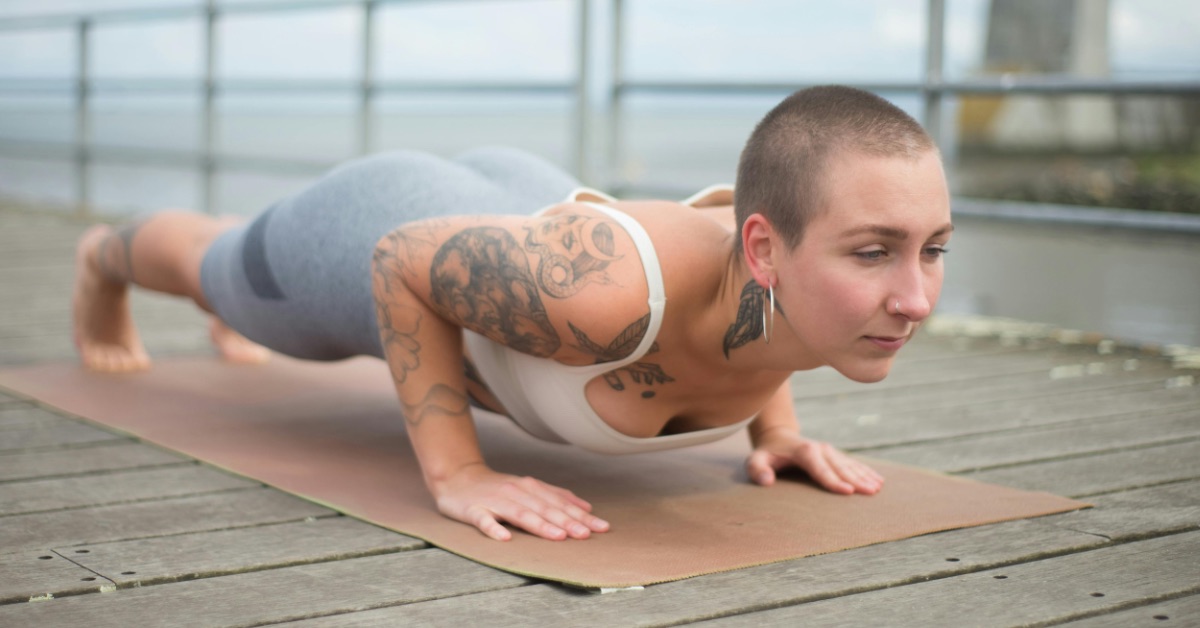
There’s a particular kind of post that does very well on “yoga Instagram”, pretty much all the time. You’ll recognise it, I’m sure: “How to finally get your caturaṅga.”, or “My five-step handstand programme.”, or “Why you can’t do lotus (or any other āsana) yet – and how to fix it.”
I want to be clear that I’m not here to criticise anyone making that content; but I’ve been sitting for a long time with something that bothers me about the collective message it sends, and I think it’s worth saying out loud.
The implicit story underneath all of it – the “yet,” the “finally,” the “fix” – is that caturaṅga, handstands, or padmāsana are where yoga goes. That they’re the point, the destination, the prize, and the only reason you’re getting on your mat. That if you can’t do them, you’re only on a journey toward being able to, and that nothing else matters.
And I don’t think that’s yoga…I think that’s gymnastics with a Sáṃskṛta label on it.
What the texts actually say
The Yoga Sūtra of Patañjali are one of the oldest and most foundational texts on yoga philosophy. They’re not the only text, and yoga isn’t a monolithic tradition – but they’re a reasonable place to look when we want to understand what āsana was originally for.
Patañjali’s definition of āsana is famously brief: sthira sukham āsanam – steady, comfortable seat. That’s it; not a particular shape; not a level of difficulty. Just a quality: steadiness, ease.
The purpose of that steady, comfortable seat, in the context of the Sūtras, is to prepare the body to be still — so that the deeper work of the practice can happen without physical distraction. Āsana was always a preparation. A means, not an end.
That reframing matters, because it changes everything about how you relate to your body on the mat. The question stops being “can I do this shape?” and becomes “can I find steadiness and ease here?”
And those are genuinely different questions with genuinely different answers.
The eight limbs – and where āsana actually sits
Here’s something that surprises a lot of people when they first hear it: in the traditional eight-limb framework of yoga, āsana is the third limb.
The first two limbs – the yama and niyama – come before it. The yama are ethical principles for how we relate to the world around us: ahiṃsā (non-harming), satya (truthfulness), asteya (non-stealing), brahmacārya (wise use of energy), aparigraha (non-grasping). The niyamas are personal observances for how we relate to ourselves: śauca (cleanliness), santoṣa (contentment), tapas (discipline or heat), svādhyāya (self-study), and īśvara praṇidhāna (surrender to something larger than the self).
Only then do we arrive at āsana. After ethics, after self-inquiry, after learning how to be in relationship with the world and with yourself.
After āsana comes prāṇāyāma – breath practices. Then pratyāhāra, the withdrawal of the senses – the practice of deliberately stepping back from the constant noise and stimulation of the world. Then dhāraṇā, concentration. Followed by dhyāna, meditation. And finally, samādhi – a state of integration, absorption, the dissolution of the ordinary sense of separation between self and experience.
That’s the full picture. And caturaṅga doesn’t appear anywhere in it.
I’m not saying this to be pedantic about the tradition. I’m saying it because understanding this framework changes the relationship people have with their practice in ways that matter – practically, daily, in the body.
The “not yet” problem
When someone tells me they’re not flexible enough for yoga, or that they tried it once but weren’t good at it, or that they’d love to start but they can’t sit cross-legged, I hear something specific underneath those words.
I hear: I went looking for yoga and what I found told me my body was the problem.
The “not yet” framing is so embedded in the way yoga gets presented – particularly online – that most people absorb it without realising. You’re not flexible enough yet. You can’t do caturaṅga yet. Your hips aren’t open enough for lotus yet. Every “yet” implies a “standard” you’re currently “failing” to meet.
And for people who already carry a complicated relationship with their bodies – which, in my experience teaching, is most of us – that framing lands in a particular place. It reinforces the very thing that makes rest and regulation difficult to access in the first place: the sense that you need to be different than you are before you can begin.
I want to say something clearly, and I want you to take a moment with it: there is no prerequisite for yoga. There is no gate. The practice is available to your body, right now, exactly as it is – not as a modification, not as a beginner’s version, not as something you’ll grow into. As yoga. As your practice.
What yoga actually gives you
I’ve been teaching for several years now, and the thing that still gets me – the thing I don’t think I’ll ever stop finding significant – is the shift that happens when someone realises the practice isn’t asking them to perform.
Not for me, not for the room, and not for themselves.
When that realisation lands, something changes in the body. A quality of permission as people begin to breathe differently, and stop bracing.
And what the practice gives them after that has almost nothing to do with flexibility.
It gives them a regulated nervous system – not permanently, not magically, but practice-by-practice, their system learns that it’s safe to settle. For people who are sensitive, who run overstimulated, who find it genuinely hard to switch off: that learning is not a small thing.
It gives them a different relationship with discomfort. Not toughness but discernment – the ability to notice sensation, to stay with it long enough to understand it, to distinguish between the discomfort that’s useful information and the sensation that’s a signal to stop. That skill lives in the body long after the mat is rolled up.
It gives them a breath they can actually use. Prāṇāyāma – breath practices – is the fourth limb of yoga, and it’s one of the most practically useful things I teach. The breath is the one part of the autonomic nervous system that we can consciously influence, which makes it a remarkably direct route from the thinking mind into the body’s stress response. When you have a breath practice, you have something to reach for at 2am, in the difficult meeting, in the waiting room. It’s always there, and it costs nothing.
And – perhaps most significantly – yoga gives people a relationship with their own bodies that isn’t organised around what those bodies can do. That shift does take time (it took me a long time), but I think it might be the most important thing the practice has to offer.
A word about what I mean by “practice”
I want to be careful here, because I don’t mean any of this as an argument against physical challenge, or against working toward something in the body, or against the āsana practice being genuinely demanding and sometimes very hard.
I have a mat-based practise. I teach āsana. I find it meaningful, and I find it difficult, and I find it genuinely joyful. None of that is in question.
What I’m pushing back on is the narrowing – the reduction of yoga to its third limb, and the reduction of that limb to its most visually impressive expressions. Caturaṅga is one posture in a vast tradition. A handstand is a party trick with good branding. Padmāsana is a seated position that many bodies will never access – comfortably or otherwise – and the classical texts would not consider that a problem.
The practice is wide. Wider than any single class format, wider than the postures, wider than the mat. It includes how you speak to yourself. It includes how you rest. It includes the quality of attention you bring to your own life.
That’s not a consolation prize for people who can’t do the impressive things. That is the thing.
If this is new information
If you’ve been reading this and thinking nobody ever told me this – I want you to know that response is extremely common, and it’s not your fault.
Yoga at it’s most visible – in studios, on social media, and in the cultural imagination – tends to lead with the physical. That’s partly a marketing decision, partly a Western inheritance, and partly just the nature of what photographs well. The result is that millions of people have a minute picture of a practice that is genuinely extraordinary in its full scope.
You can come to yoga through āsana, and many people do, and that’s completely fine. But you can also come to it through the breath, or through meditation, or through the ethical inquiry of the yama, or through the self-study of svādhyāya. There are eight doors in, and none of them require a handstand.
If you’re curious about what a practice that actually works for your body and your nervous system might look like – that’s what I do. That’s the work I’m most interested in, and it starts exactly where you are.

