8–11 minutes
There’s a version of rest that most of us are very familiar with: it comes at the end of a long day, or a long week, when you’ve finally done enough – or simply given up trying. You lie down, you scroll, or you stare at the ceiling, or you half-watch something you’ve already seen on the big screen while you have a little screen in your hand, too. And somewhere in the background, a low-level hum: I should be doing something; I’ll feel better when this is done; I’ll rest properly once I’ve got on top of things.
That hum – that’s what I want to talk about today.
Because that’s not rest, that’s suspension; and most of us have been living in suspension for so long that we’ve forgotten there’s even a difference.
The thing nobody told us
We weren’t, as a culture, taught how to rest. We were shamed for sitting down – called “lazy”, maybe even “ungrateful”, as we were taught only how to be productive. We were taught the goal of rest was to be productive again, soon. We were taught that rest is what you earn, not what you need – something you get to do in proportion, once all the work is done, the inbox is empty, the house is tidy, the list is finished, and nobody needs us.
The list is never finished; there’s always a new email; and somebody always wants us to do something so they don’t have to.
And so most of us move through our lives in a state of low-grade depletion, permanently slightly behind, taking breaks that don’t actually restore us and wondering why we’re still tired (or exhausted, if we’re honest).
This isn’t a personal failing, it’s not a discipline problem, or a motivation problem, or even a matter of simply needing to prioritise better. It’s a nervous system problem – and it needs a different solution than just “finding the time”.
What the nervous system actually needs
Your nervous system has two main modes: activation and rest. You’ve probably heard them described as fight-or-flight and rest-and-digest. In the yoga tradition, these map loosely onto the concept of prāṇa – life force or energy – and how it flows through the body.
When we’re in activation mode, everything is oriented toward response: heart rate up; breath shallow; attention narrowed. The body is doing exactly what it’s designed to do in the face of a threat.
The problem is that modern life is relentlessly activating with notifications, deadlines, noise, the news, the inbox, the other inbox, the mental load of simply being a person right now – all of which reads, to the nervous system, as something to respond to. And our nervous systems don’t know a lion from yet another sales email from that company. It just knows: something requires your attention.
So we stay activated; we learn to function from within that activation and we stop noticing how tightly wound we are because that becomes our baseline.
Rest, in this context, isn’t laziness, it’s biology. Your nervous system needs regular opportunities to downregulate that is to shift out of response mode and into genuine recovery. Without that, we stay dysregulated. Sleep becomes less restorative; small things feel disproportionately hard; the capacity to be present, to be creative, to be kind – it all erodes.
You’re not failing at life – your nervous system is simply exhausted and it doesn’t know how to stop.
Why “just relax” doesn’t work
Here’s the thing about relaxation: it is a skill.
Like any skill, it can be learned, practised, and improved; and like any skill, you can’t just will yourself into competence without the right conditions and a bit of guidance.
“Just relax” is not an instruction, it’s an aspiration with no method attached.
When someone who is chronically activated tries to relax – really and actually relax – they often find that they can’t. Their body lies down but it’s almost as if their brain stays standing. Their eyes close, but the thoughts speed up; rest then feels, not like relief, but like confrontation – with everything they haven’t done, everything they’re worried about, everything they’ve been too busy to feel bubbling up to the surface.
This isn’t a sign that something is wrong with you; but it is a sign that your nervous system has been so consistently in activation mode that slowing down is unfamiliar; perhaps even uncomfortable, and your body doesn’t quite trust it.
Which is exactly why it needs to be practised, not just attempted.
Where yoga comes in – and I don’t mean the stretching part
Yoga, in its fullest form, is an eight-limbed system. Āsana – the physical postures – is the third limb. It gets considerable airtime on social media and rather less in Patañjali’s Yoga Sūtras, where it occupies roughly three verses.
The other seven limbs are equally real and, for a lot of people, considerably more transformative.
Prāṇāyāma – the fourth limb – (often called “breathwork” in the west) is the deliberate regulation of breath, which in turn regulates the nervous system, the mind, and the flow of energy through the body. This is not breathing exercises in the sense of inhale for four, hold for four, exhale for four (though that’s a perfectly good place to start); this is a sophisticated system for working with the breath as a bridge between the conscious and unconscious, the voluntary and the involuntary, the mind and the body.
Pratyāhāra – the fifth limb – is the withdrawal of the senses, or turning our attention inward. In a world of infinite scroll and constant stimulation, this might be the most radical act available to us: it asks nothing more than to stop taking input for a moment; just be where you are, without receiving anything.
These practices, along with the ethical foundations of the first two limbs (yama and niyama) and the deeper states of concentration and meditation that follow, are the parts of yoga that most profoundly affect the nervous system. Not because they’re mystical – though they can feel that way – but because they work.
The breath is the most direct voluntary pathway into the autonomic nervous system. The body, held in stillness, sends safety signals to the brain; and the mind, given a focal point, stops generating threat responses.
Yoga is, among other things, a very old technology for nervous system regulation.
Yoga nidrā: rest with a method
Of all the practices in the yoga tradition, yoga nidrā is the one I return to most often – in my own practice, and in the work I do with others.
Yoga nidrā translates, roughly, as “yogic sleep”. It’s a guided practice that systematically brings the body into a state of deep rest while the mind remains gently aware. The practitioner lies down while a teacher guides them through some or all of: a rotation of awareness; pairs of opposites; visualisation; and an extended state of restful presence. The body enters a state that research suggests resembles the hypnagogic state between waking and sleep – deeply restorative, deeply receptive.
People often describe coming out of a yoga nidrā session feeling as though they’ve slept for hours; some people do fall asleep, and that’s fine – the practice works either way. The point is not to stay awake and concentrate, but to give your nervous system a genuine, structured opportunity to let go.
This is rest with a method, not an aspiration or a vague instruction to calm down; a practice with a clear beginning, a clear structure, and a clear end – and the means to actually get there.
It’s also, crucially, something you can learn. The more regularly you practise yoga nidrā, the more readily your nervous system learns to access that state – the downregulation becomes more familiar, more available, and – eventually – more automatic.
You’re not just resting; you’re teaching your body that rest is safe.
The permission you were never given
In case it’s not yet clear from what I’ve been saying: you do not have to earn rest.
Not today, not this week, not once the project is finished, or the children are older, or things calm down a bit. You don’t have to be in crisis to deserve support; and you don’t have to have exhausted every other option before you allow yourself to stop.
Rest isn’t a reward; it is a necessity. And the cultural story that tells us otherwise – that productivity is virtue, that busyness signals worth, that stopping is self-indulgent – does genuine harm to genuine people.
You’re allowed to stop, you’re allowed to be still; you’re allowed to take an hour, or an afternoon, or a whole weekend, and fill it with nothing more purposeful than recovery.
And if you’ve been on the go for so long that you don’t quite know how to do that – if the stopping feels uncomfortable, or guilty, or unfamiliar – then that’s exactly what the practice of yoga nidrā is for.
You don’t have to figure it out alone; you just have to be willing to try something different.
Where to start
If any of this has resonated and you’re not sure where to begin, here are a few places:
Viparīta karaṇī (legs-up-the-wall) is one of the simplest and most effective practices I know. Lie on your back, legs resting up against a wall, hips as close to the wall as is comfortable; stay for five to fifteen minutes, or more. Let your breath slow and your legs get heavy. It requires nothing – no equipment, no experience, no flexibility – and it genuinely works.
Sama vṛtti (equal ratio or “box” breathing) is a prāṇāyāma practice that centres and calms the nervous system. Even two minutes can shift something. I have a guide on my YouTube channel if you’d like to try it.
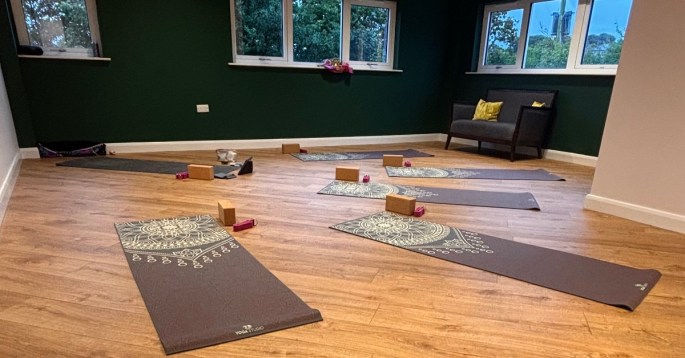
Yoga nidrā is available to try for free on my Insight Timer profile – or if you’d like a guided, supported experience with a small group, my monthly Strong Enough to Rest sessions are exactly that. The next one is Sunday July 5th at 2:30pm in Whitehaven, Cumbria.
And if you’d like something more tailored – a practice built around what you actually need, with space to explore what’s going on for you and how yoga can genuinely help – my 1:1 work is a good place to start. You don’t need to know what you’re looking for, that’s what the first conversation is for.
Rest isn’t the absence of doing. It’s the presence of being.
And you’ve always been allowed to be here.
Rest & Rise is a yoga and wellness brand based in West Cumbria. Sam teaches across all eight limbs of yoga with a focus on nervous system regulation and accessibility. Find out more at the link in bio, or explore free content on YouTube.